Rolf Sachsse
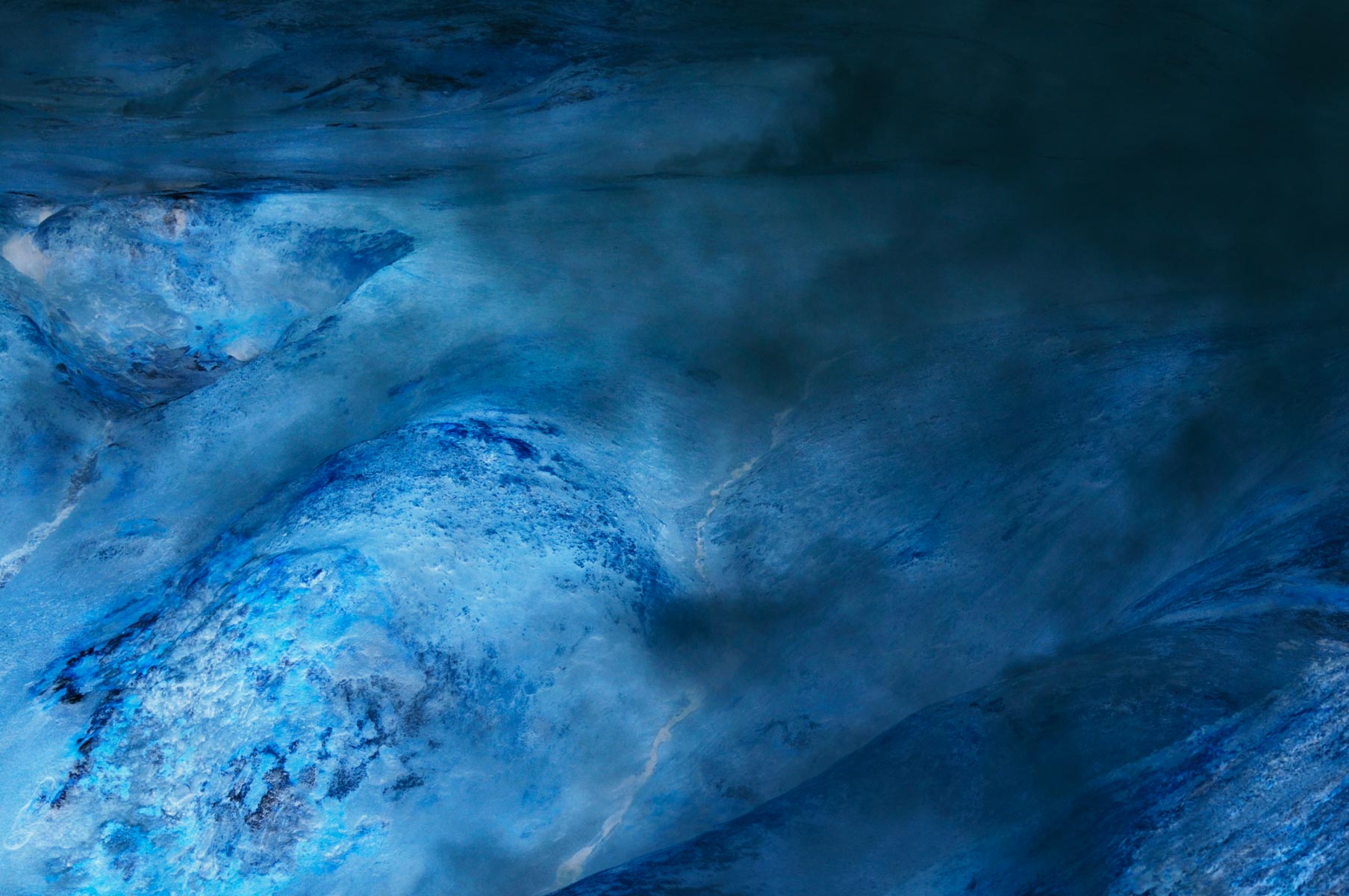
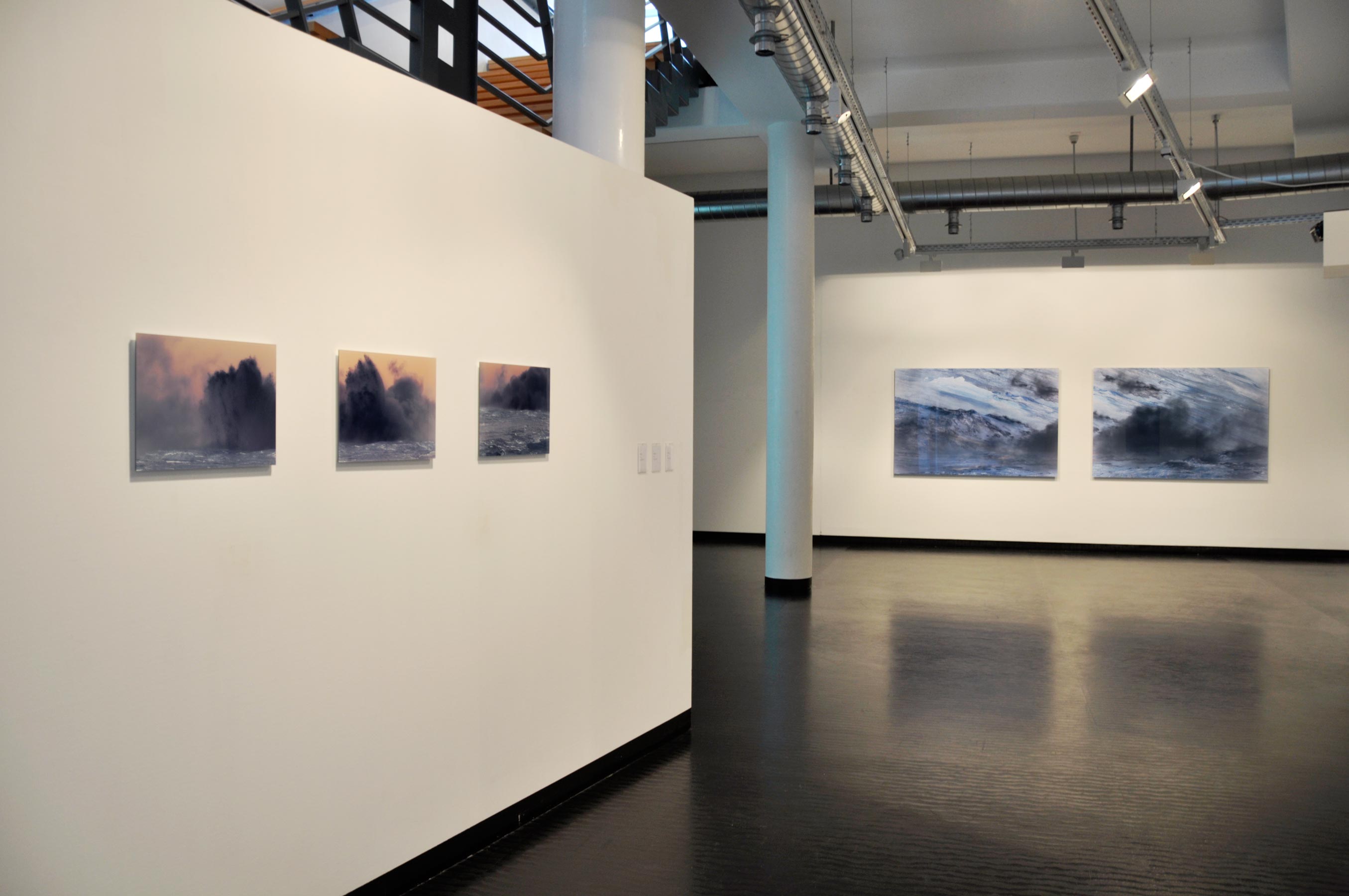
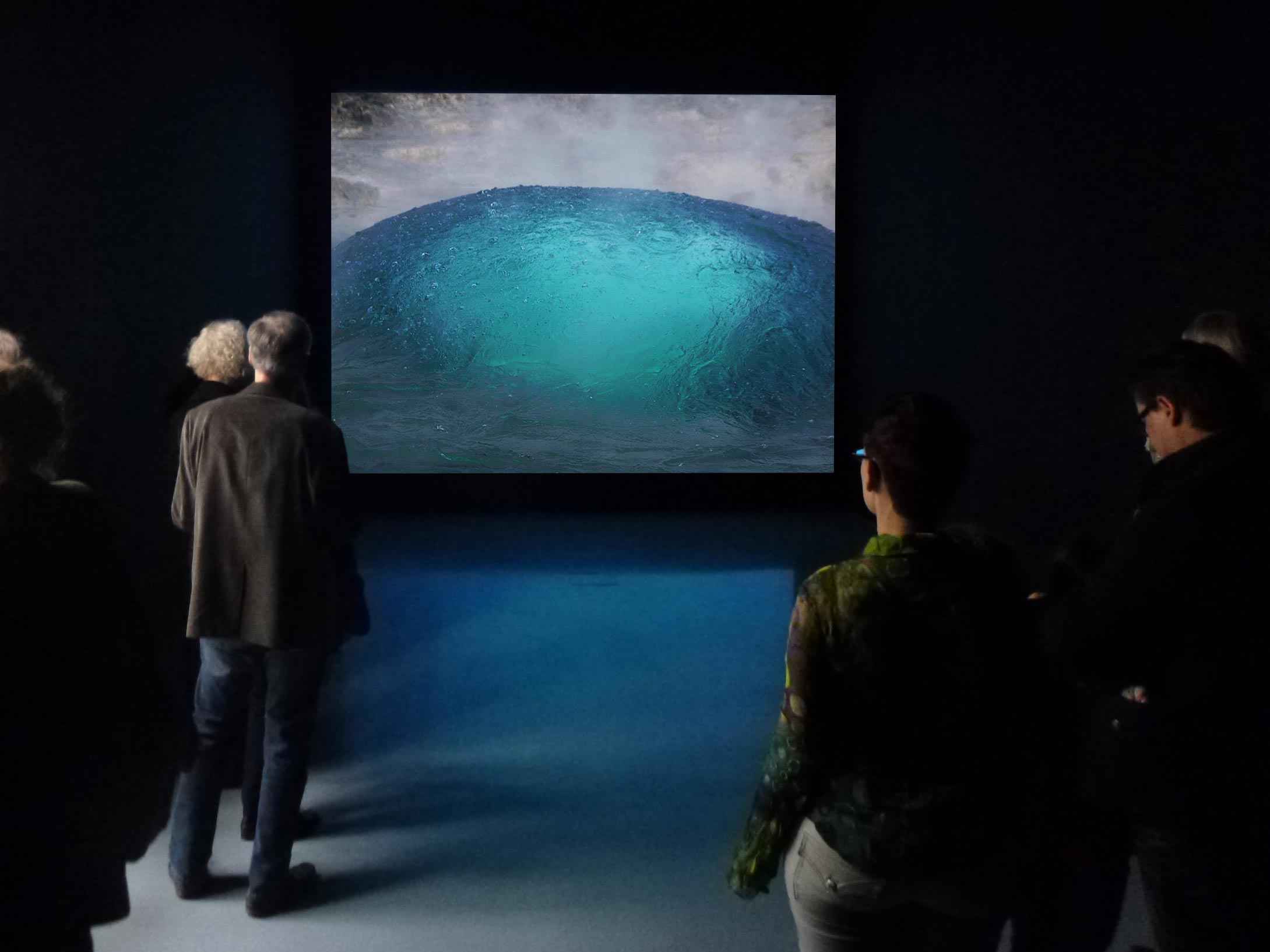
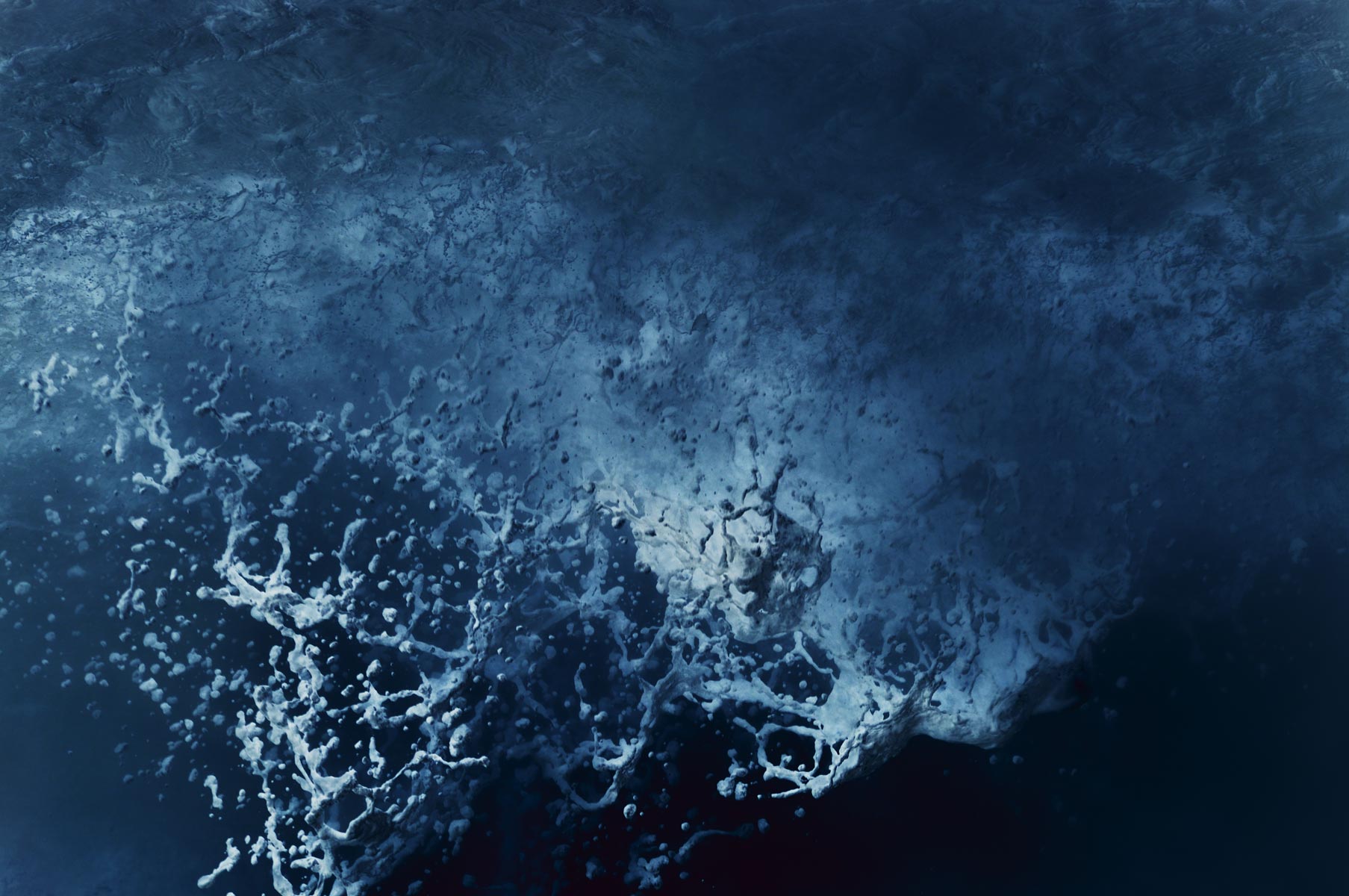
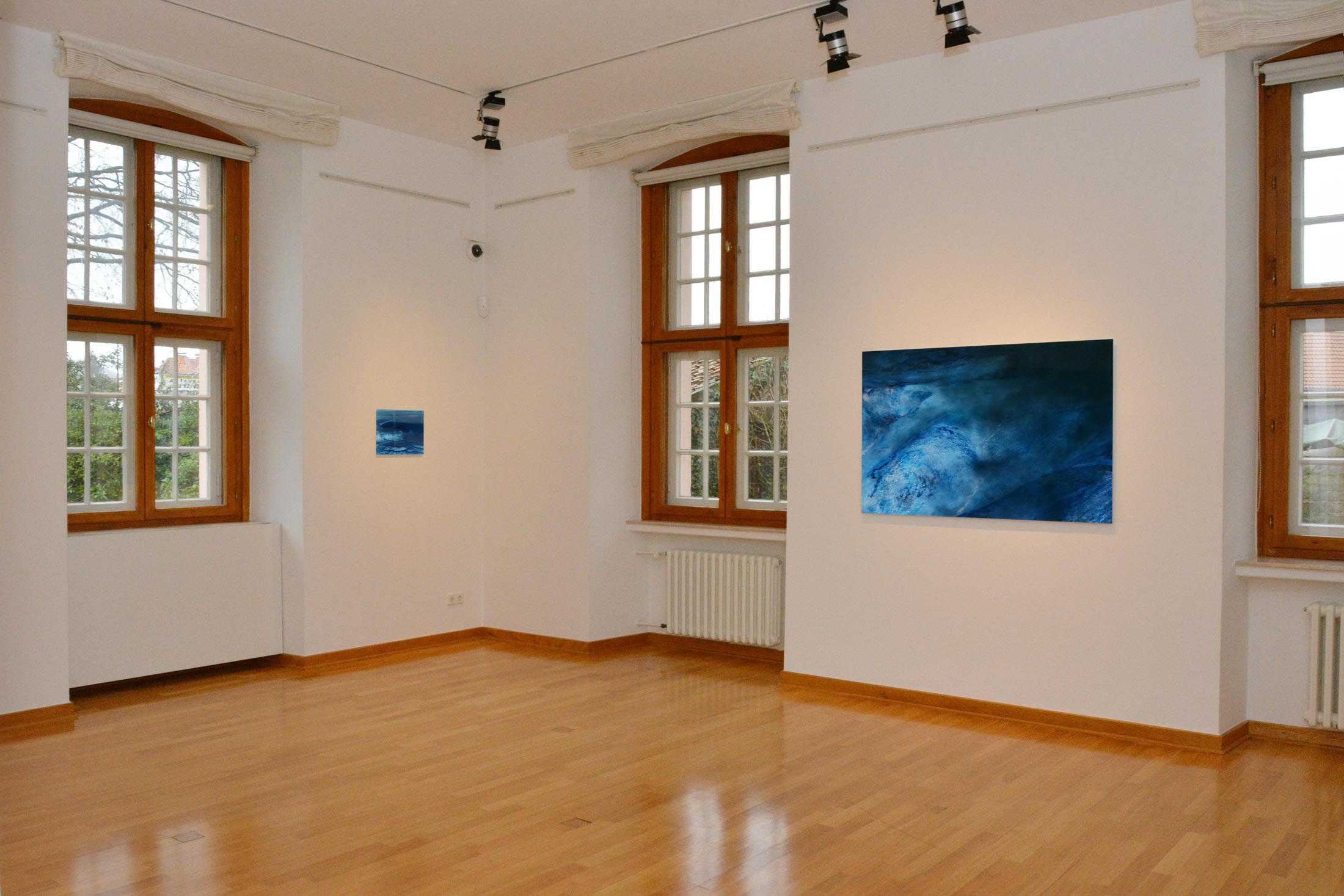
This is what we see: Water – rearing up, foaming, splashing; in eruptions, fountains, waves and wild currents. All this is displayed in indefinable depths, yet powerful, and almost always against a dark sky and permeated by a dense fog. The water is presented in all different refractions, clear as day and awash with sea spray, almost every drop of it recognizable, yet blurred movements flow to the side. There can be no question that the artist Melanie Wiora, who studied painting, understands her artwork well as a photographer.
Large color images are presented in this new series by Melanie Wiora. As dramatic as the situation in each individual image appears, the positioning of the camera is still difficult to determine. Where exactly the waves foam, where the geysers spray, where the horizon of water, fog and clouds lies, Wiora does not tell us. What matters to her is both the power that the image creates, and the fragment of wild events which she photographed. Together, these priorities both follow a logic which – as in her earlier work – orients itself on the perception of images in general. A first indication is given by the choice of the title of this new series: Natura.
“I would like to suggest that we can better understand nature if we understand it as a cultural product subjugated by historical change,” writes the Hildeshim philosopher Tilman Borsche, and then goes on to address the dissolution of the concept of nature ever since the Renaissance. Throughout ancient times and the Christian-influenced Middle Ages, the term ‘nature’ was used to describe the divine nature of the individual. Today it is still heard in sayings such as “It is in his nature.” However, ever since man has become the object both of his own self-knowledge and of science, nature has come to mean the unknown, the other, the wild, the indefinite, but also the fascinating – both in the positive and negative sense. After working on the act of seeing and the human image in her impressive series up to now, Melanie Wiora places her new work at the interface between shock and surprise, between curiosity and rejection, and for this she has chosen the most appropriate medium: photography.
It is the first technical image medium to become second nature to us in our own information processing. There is no place on Earth we can go that we have not already seen in some media. When we remember something, it is difficult to distinguish between the real experience and the medial image. Both have been perceived in the real sense of the word. But a new problem has cropped up among these images, and that is the central issue in this series by Melanie Wiora: How does our own nature deal with the images of the unknown, the other and the natural world? Is it possible for us to recognize these as such? How do you embrace a picture of nature without having a real situation to remember? Melanie Wiora not only introduces a classic problem of perception of photography, but asks directly about the meaning and effect of visual art.
The philosopher Baruch Spinoza considered natura naturans and God to be identical, a nature which creates itself, this idea strongly contrasting with the scholastic natura naturata, the manmade nature-like things, as described by Martin Heidegger later. Had Melanie Wiora limited herself to the natura mediata – meaning the mere depiction of natural forms – her work would hardly be recognizable, much less describable, as art. But she has created the natura medians, which moves itself into the picture or which represents itself. She points her camera at the action and captures the image, but her art does not stop there. The resulting picture of the event or situation is merely raw material. In the classic work process it would be the sketch or study. In analog photography it would be the negative or slide, but not the final image, the appearance on paper in the exhibition and book. So the result is a natura medians, showing a picture of nature that may appear probable if we look at it, yet we also recognize it as nature that is created, produced, or shaped, namely as the art of Melanie Wiora.
After the photograph is before the photograph, the media theorist Hubertus von Amelunxen once wrote cryptically – and in the Natura pictures by Melanie Wiora one would be quite apt to agree with this statement. No photograph remains unchanged when it becomes a picture. Contrast and color adjustments, the choice of the printing process, determination of size, surface, framing – these are all measures with only one goal, and that is indeed the same before, during and after the photograph: a picture or a series of pictures. In this respect, Melanie Wiora aims at a specific result: the best picture.
In her photographic works Melanie Wiora uses a very specific color scale, one which at first glance may appear somewhat cool. Many of her pictures show an overcast, cloudy sky. The basic light corresponds to a rainy day in Western or Central Europe: it is bluish gray and direct sunlight rarely makes an appearance. All this holds true for the new pictures also, and yet they are different. For the first time color and contrast are not used as a narrative, but as elements of the composition. More than in any of the other series by Melanie Wiora, you first see here a carefully composed space, and only then do you begin to alternate between the vague recognition of a situation and the viewing of a composed space. It is nearly impossible for the observing eye to stop moving back and forth. Monochrome sensations stimulate the brain, and the search to determine the scale of the scene to solve the puzzle may cause the viewer to despair. But whatever you see, they are still pictures, even beautiful ones, and occasionally perhaps even eerily beautiful.
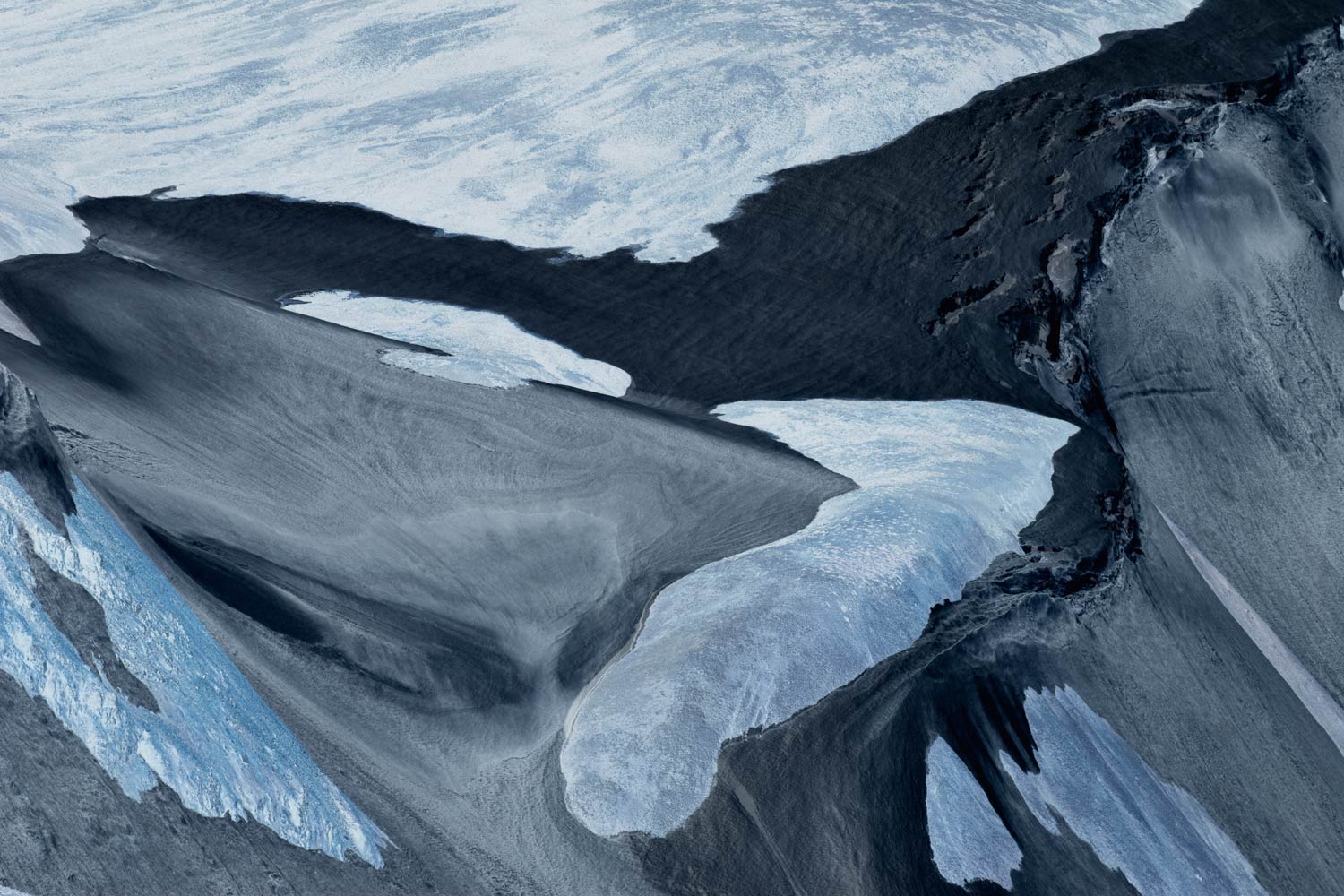
The colors are responsible for the chill felt by the viewer. No blue sky comes to lighten the viewer’s disposition. Dark clouds threaten, and often there are clouds and walls of fog blocking the view from the depths. Here and there areas of precise water formations appear, yet they are strictly delineated and impossible to locate in the depths of the image. These areas are often significantly brighter than the surrounding curtain of air, water, and fog. This movement within the image also serves a function of perception. The observation is thrown back into the picture itself. Thus, it can accept the picture as a surface, similar to the ideas of Cezanne, who viewed every picture as a piece of painted canvas and thus was a pioneer of abstract art. Therefore, it is good to view the pictures of Melanie Wiora from the perspective of abstract photography.
Snapping the pictures back into the photographic plane opens us up to the small sensations of which the pictures of the Natura series offer many: First, there are the many microstructures of spray and overlapping foaming waves which can be seen as informel persisting in front of the form. They lend the pictures a structure which is part and parcel of all abstract art. On the other hand, in small areas of the image it provides islands of realization: closed circles, bark-like bars, dark delineated squares. They are usually not recognized as separate forms, but provide the viewer with the necessary elements of interest to be moved by the image. Finally the path ends which first led to the picture and then back away from it, while looking at diagonal and horizontal space dividers formed by waves, spray and quiet zones of the water. These make up the actual image.
Nevertheless, formalism is not the primary concern of the artist Melanie Wiora. She begins her work with the great wonder of the knowing eye, then she seeks out the necessary techniques of implementation, and finally, one after another, quietly emerge a series of images that can release a multitude of associations on the one hand, but on the other hand develop such a large life of their own that they each could stand alone. They are technically generated images. They take a moment out of nature and give it to us viewers in highly developed forms. Finally, they stand for themselves; they are themselves – simply as images natura medians.
In "Natura", catalogue, Dr. Isabella Kreim (editor), Kunstverein Ingolstadt, Revolver Publishing, 2010
Franziska Nori and Christiane Feser
One of the central themes of Melanie Wiora’s work is the relationship between the mental world and the possibility of its photographic representation. The artist emblematically highlights the connection between reality, image and the eye of the beholder, elements whose mutual relationships determine the nature of the photograph.
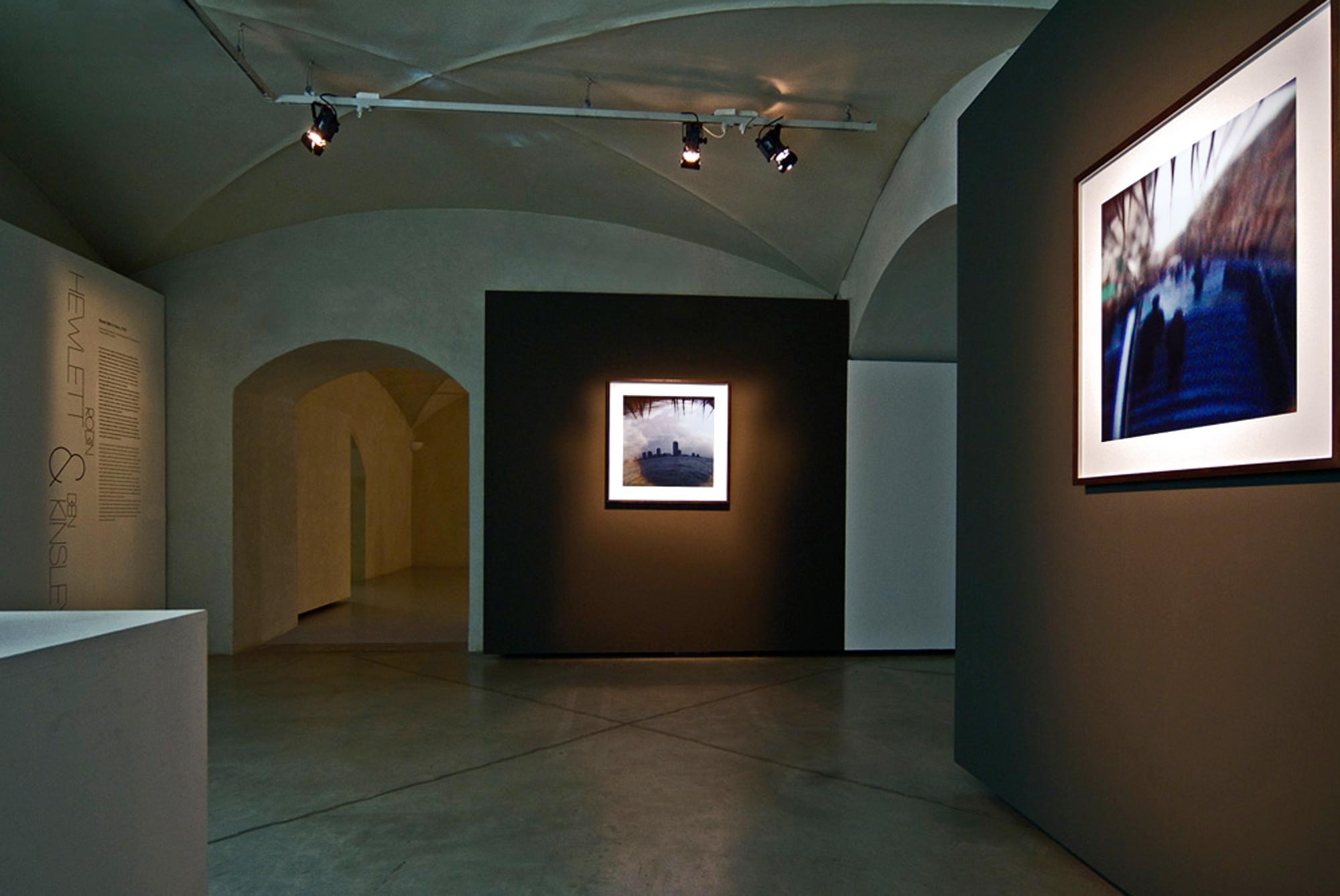
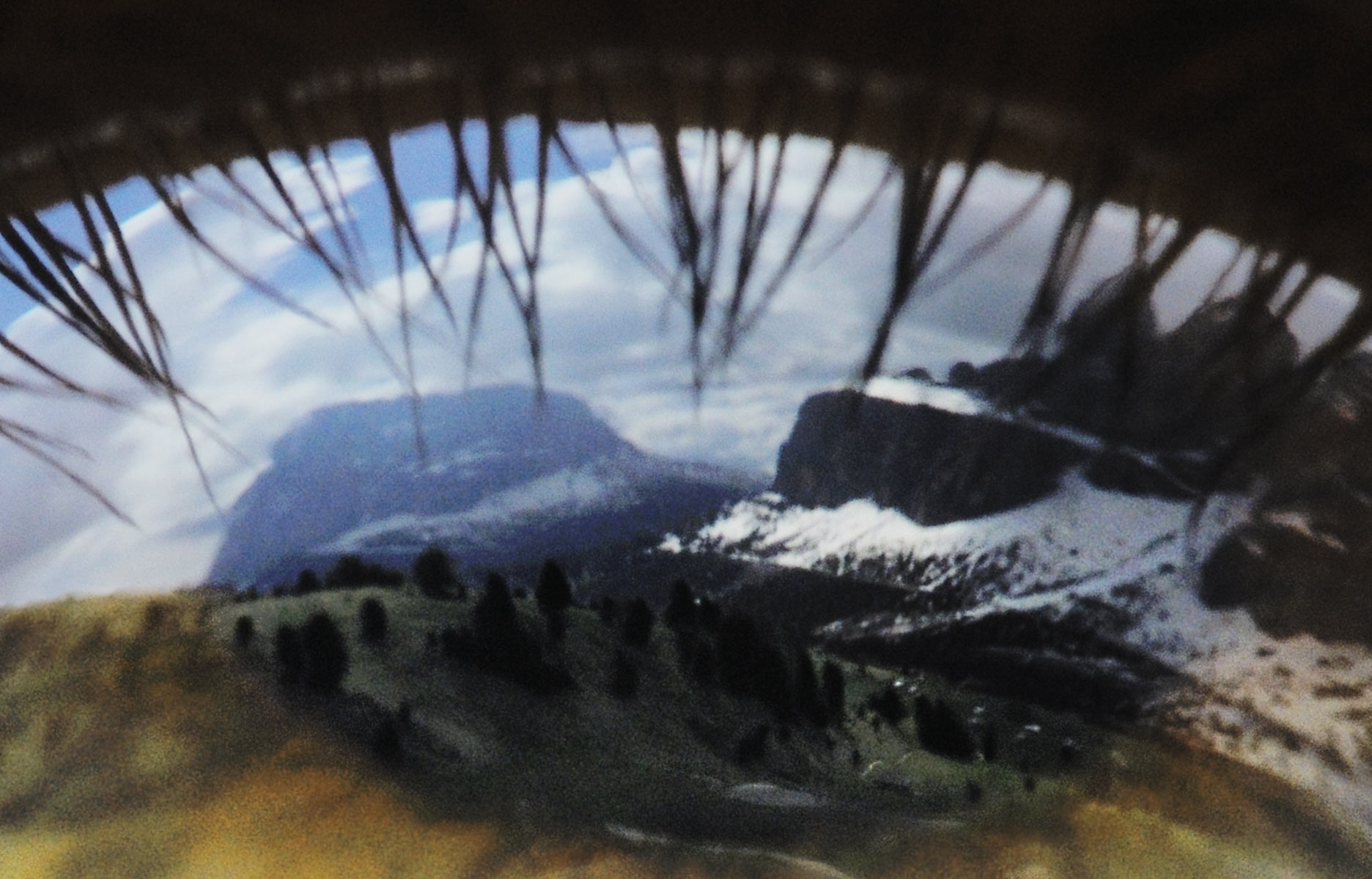
In the photographs of the Eyescapes series we see simple subjects first of all: a city skyline, houses, trees and streets. These scenarios are delimited in the upper part of the image by a rounded horizon with no sharply defined lines. This is in fact the close-up image of an eye that fills up the photographic field with the environment reflected in its convex iris. Melanie Wiora uses a digital camera to photograph her own eye and then processes the photograph by computer to make the effects of reflection more clearly recognizable.
Eyescapes, the title of the series, alludes to the genre of landscape painting. By replacing “land” with “eye”, the artist significantly suggests the idea of the iris as canvas and the subjective landscape of the eye. The extreme close-up photographs of the iris show an image of the world reflected in the eye of the beholder, which is the photograph itself in this case. We thus see what Melanie Wiora sees and the images become a metaphor of the essence of photography: not an authentic representation of the world but a reproduction of what the photographer wants to show us, her specific way of looking at reality. Finally, as the artist herself recalls, the second and crucial element influencing the content and message of photograph is the observer: “I’m interested in creating pictures which provide viewers with insights. Not confined purely to visual perception, the pictures also rouse the imagination and memories.”
Franziska Nori (project director CCCS), Christiane Feser, published in the catalogue accompanying the exhibition "Manipulating Reality - How Images redefine the World", 2009, Centro di Cultura Contemporanea Strozzina, Palazzo Strozzi, Florence
Martina Junghans
The camera approaches, zooming in so close to the body that
a solitary eye ultimately remains visible. The eye belongs to the photographer
and reflects the rest of the world for us. Using a digital camera, Melanie
Wiora lines up her own eye in her sights. It is near enough to render visible
the images reflected by its outer membrane. Instead of portraying the rest
of the world in detail, however, the eye's colours and contours resolve the
reflections to an extent where only fragments remain at the surface. Other
components appear to recede into the depths and send back impressions.
Involuntarily, the beholder attempts to enhance and define
the images more sharply with personal associations in order to translate them
into new cognitive structures: "I'm interested in creating pictures which
provide viewers with insights. Not confined purely to visual perception, the
pictures also rouse the imagination and memories", says Melanie Wiora.
She selects simple titles for her photographs, such as Houses, Path,
Bridge, By the Water and In the Mountains. Instead of
offering viewers abridged accounts of scenes, these expressions focus attention
on visual content and trigger processes of inspection and interpretation.
The themes are familiar, yet the context so indefinite so
as to prompt more detailed recall: A forked tree with a row of tall trees
in the background, a narrow stony brook between gently rolling hillocks, a
steep staircase, a house at the top left? The eye serves as a window, not
always clearly indicating whether the aperture is directed inwards or outwards.
The eyelashes sweeping in from the upper edge of the picture open up the multi-layered
visual space, creating an interplay between both spheres of reality.
The idea that photography provides a documentary record
of material being is negated by the photographs from the start. Melanie Wiora
uses photography in conjunction with her own resources, perspective selections
and computer-aided post-processing techniques to result in transformations
which no longer permit an unmistakable construal of vision and reality. Various
image and depth layers slide across each other on the eye's thin membrane.
Although the individual image sources are identifiable, their respective contributions
to the overall picture cannot be clearly described.
Supplemented and accompanied by personal pictures and ideas,
the photographs are lent a tangible, subjective character far exceeding the
scope of their determinate, visual substance.
Melanie Wiora leads viewers to the outer reaches of optical
sensory perception which continue to unfold and become sharper the more closely
they are observed. All told, a scrutiny and evaluation of Melanie Wiora's
photographs reveal that, in the beginning, the world is in the eye of the
beholder.
In "Eyescapes", catalogue, Franz Dudenhöffer (editor), Kunstverein Speyer, Bild & Kunst, 2003
top
Rolf Sachsse
When we approach people, we look into their eyes – an ancient reflex for the precautionary prevention of aggressions or for starting an erotic relationship. What they see in the other’s eyes depends on focusing their eyes, once again a very intimate act – making contact long before speaking. We usually look at the other person’s iris, registering its color and the pupil’s dilation, from which excitement, fatigue or attractiveness of the other are inferred. In certain circumstances, the other’s eyes may show one’s own reflection – though the two must be very close for that. The invitation to look another person in the eyes is made only after that first moment of meeting has passed, which is so important for the connection of the people to one another.
This moment lasts an average of seven-tenths of a second. Then the two people know whether they want to draw closer or to move away from each other. At this point all the information needed by the body for its protection is computed – and then the amygdala can authorize the processing of what has been seen in the frontal lobe and compare it to particles of memory or metaphor in Wernicke’s area. Interest, happiness, disgust, fright: The conclusions depend on these first impressions. Yet they also form what becomes the afterimage in the brain – and this is where art begins. For it is this which makes the afterimage into a symbol of the uniqueness of the reflected existence.
It is precisely this initial moment which Melanie Wiora presents in her pictures, and it makes her work so fascinating, particularly in the selection of her subjects and motifs. Where landscapes, stairs and buildings were reflected in Melanie Wiora’s eye in her early Eyescapes, in her Personal Reflections the object is now a situation characterized by human beings and one resulting from their actions. Finding the exceptional in the general aspect of these situations is a common theme of photographic art in our time: Brief encounters in the street, everyday manual labor such as unloading a truck, waiting at an intersection for the light to change, and people passing each other can be found again as constant motives in the works of Thomas Struth and Beat Streuli as well as in the paintings of Eric Fischl and Lisa Ruyters. Melanie Wiora shares with these artists the view of the specific or special aspect of a gesture or of a posture which develops into art the moment it is seen – and yet her view is more subjective and more personal; it no longer strives toward abstraction and generalization like the art of the 1990s.
The reflected view is always framed by the artist’s eyelashes and by a likeness of the reflection in her iris which forms the lower contour of the picture’s composition. By using eyelashes, Melanie Wiora’s pictures refer to an old view of the history of art and architecture, that of the eye as a curtain in a theater. The most compelling version of this view was drawn by the revolutionary architect Claude-Nicolas Ledoux in 1775 with his theater of Besançon, exactly like Melanie Wiora’s experimental order, though without color and in precise focus. From there it is but a small step to the slicing of the eyeball in the opening sequence of the movie un chien andalou, made by Luis Buñuel and Salvador Dalí in 1928, which, for its part, has much in common with the closeness of the examination with the eye used by Melanie Wiora. But Melanie Wiora spares us from the all too sharp focus of Ledoux and Buñuel through the technique of her picture-taking procedure and the honesty with which she only slightly processes her pictures. Yet even Ledoux’s pictorial view into the theatrum mundi is a quotation, which picks up on the earliest evidence of the history of pictures and art: the curtain in front of every picture of the classical antiquity, which was drawn aside in order to present the work in view of the public. In the contest between Zeuxis and Parrhasios, the young challenger simply painted a curtain, behind which could be hidden anything that could present itself to the painter’s eye and therefore be paintable. Old Zeuxis admitted his defeat, without ever knowing what could have been behind the painted curtain. Today, we can see just as little behind the reflections in the eyes of Melanie Wiora to learn which aspects of the picture have been processed in her brain. Something else connects Melanie Wiora to the painting of the antiquity or of modern times: colorfulness.
Her pictures are in color, actually in a slightly misty cyan hue, which is characteristic of looking at a wet mirror. The reflections of such surfaces can be found in everyday life in oily puddles and were, in color or black-and-white, an important topic after 1950 of a German “subjective photography” as the first movement toward an integration of photography in the arts after the Second World War. The characteristic features of the colored reflection refers to the physical phenomena of surface tension, which enjoyed a broad reception particularly in the German-speaking art world of the 1960s and 1970s, from the architecture of the finite elements to the pneumatic works of the Viennese actionists. In art as well as in the sciences, fluid surface tensions have become a metaphor for a fleeting transitional state that offers unusual possibilities for perception – corresponding to the moment.
The reflections of the people and situations in the pictures are circulinearly curved; they are endowed with the perspective that was discovered by the architects Albert Flocon and Andreas Feininger around 1950 to be the actual, natural one, resulting in the triumphant advances of the so-called fish-eye lens. This perspective, too, has a long media history behind it, which has left its traces in Melanie Wiora’s work – from André Kertész’s mirror-image distortion to the panoramic-world constructions of Jeffrey Shaw and Miroslav Rogala. However, while the latter artists consider the software and the process of the picture-creation initiated by it to be almost more important than the aesthetic result itself, Melanie Wiora – with her basic look in the eye – refers more to the fundamental experience of that look – of every look – and its orientation in the room.
After a second glance at Melanie Wiora’s pictures, it becomes clear – from the similarity of the eyelashes – that it is the eye of the artist into which one looks while viewing the picture. It is no longer the framing by means of a self-portrait but an act of extreme intimacy because we as observers come within inches of her, and in spite of the more or less average size of the pictures, they have a rather frightfully monumental effect. What is reflected in the artist’s eye may be an everyday scene. However, through the alignment as the picture is taken, the gaze is literally fixed and becomes a metaphor of every possible human encounter. The idea of an unbearable physical closeness is softened both by the fuzziness which is naturally caused by the reflection in the eye’s liquid, and also by the extreme close-up views of the camera which are the nature of such pictures. Slight waves of the eye’s surface in the image, the more or less strong spatial curvature of the round pupil, and the occasional, technically induced motion blurs create the distance from what is happening that makes possible the perception of the image as an image.
Thus, Melanie Wiora succeeds with a small step in making a great effect. When observers have begun to become aware of the technique and form of the picture’s creation process, they recognize the fundamental meaning of the depicted situation. In the afterimage of the second glance at the finished picture, there is a movement of the everyday situation into the metaphorical, fundamental nature of art through the choice of a genuine process in the creation of the picture. With this, Melanie Wiora has succeeded in a rare and certainly successful strategy of structuring that which may be described as a post-medial construction of art: a work in the media that reaches beyond the medial effect and, in its presentation, refers back to the individual work.
In "Beyond the Moment", catalogue, Helmut A. Müller (editor), Hospitalhof Stuttgart, Edition Hospitalhof Stuttgart, 2005
Melanie Wiora
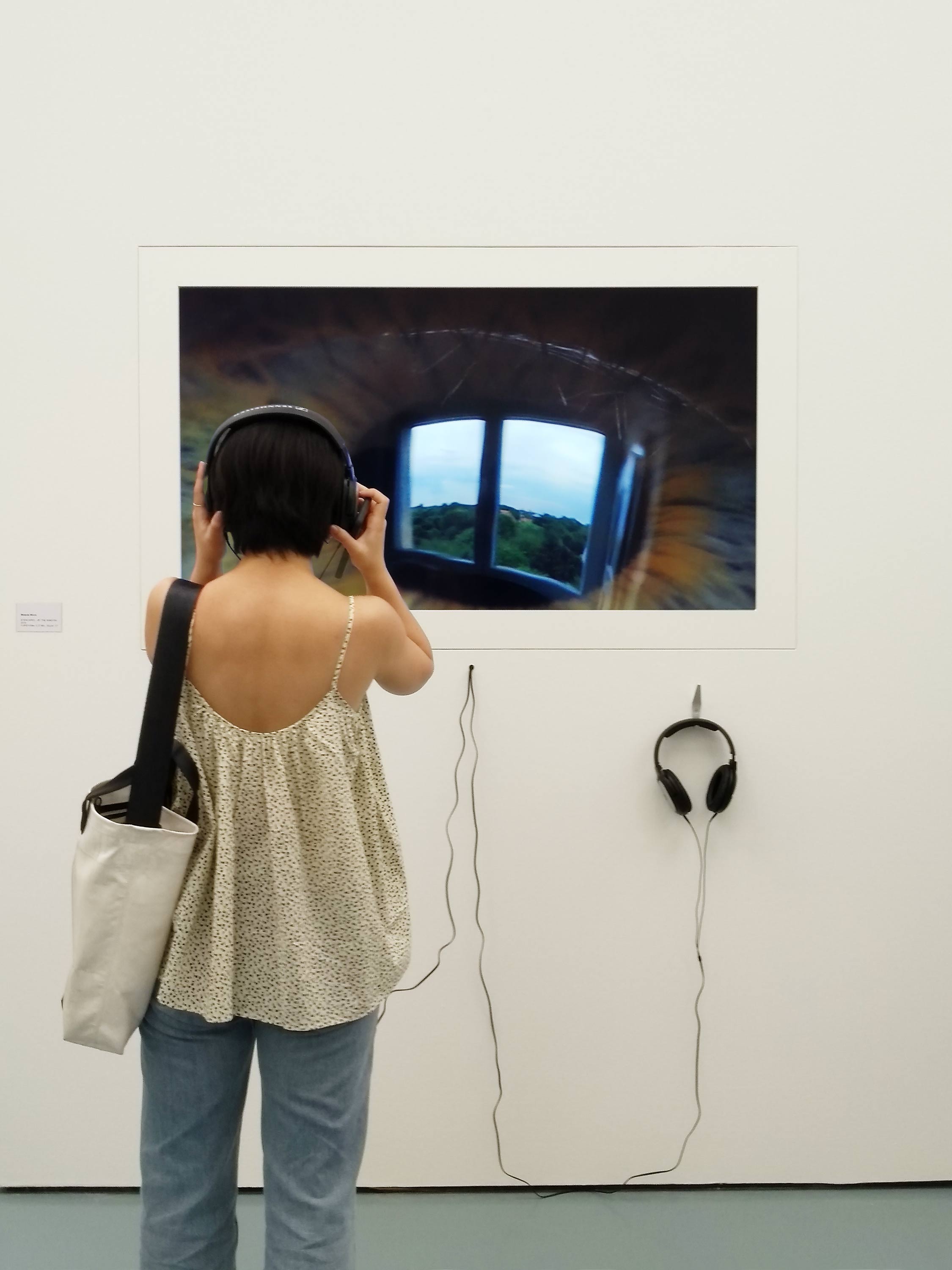
My video installation Eyescapes - By the Water shows
three projections of a river landscape. The pictures are reflections on my
eye that I filmed while looking into the landscape. The landscape as well
as the lashes and the lids are mirrored. The colours of the iris and the pupil
partially overlap the scenery. In effect, the installation shows views into
a familiar, yet changed world.
The three video projections consist of a calm sequence,
in which the eye focuses on a tree. The following sequence shows a rotary
motion in which the images of the surrounding landscape pass through the surface
of the eye. The eye moves slowly upward into the sky. When the eye scanning
the landscape seizes the fork of the tree the direction of the movement changes.
The eye lowers down to the river scenery again. The cycle is repeated.
The video projections are temporally shifted. In effect
the landscape seems to move from left to right. The impression of rotation
becomes intensified. The space created by the three projections is developing
a strong rhythm of calm and movement.
Helmut A. Müller
For the media theoretician Vilém Flusser, perception
is also subject to the laws of entropy. We notice only what is unusual and
new, yet only for a certain period of time. What was once new does not stay
new for long. After a phase of habituation, it cools off and is overlooked.
On this premise, aesthetics appears to be caught between the pole of unattainable
density in the uniqueness of a big bang and that of absolute indifference.1
Considered from this point of view, mans work, art, culture, religion
and even science would be seen as strivings against indifference, disregard
and neglect. Photography and, in particular, artistic photography such as
Melanie Wioras is also involved in this pursuit. For Vilém
Flusser, pictures taken by cameras and the written word participate in the
interaction with symbolic images and concepts and thus in the struggle for
the possibilities of new awareness. The task of photography, according to
Flussers theory, would be to have the programs in the cameras submit
to human intention. The best type of photography would be that “by
which the photographer subjects the cameras program to his or her
own human objective.”2
In her new series Outside is in me, Wiora focuses
her efforts against the apparatus by digitally enhancing the pictures which
are produced with the help of the cameras programs, and converting
them into new, intensive and dense pictures poised between external and
internal perception. The series, which presents the photographs in square
format, shows portraits of people who are cut off by the outer edge of the
picture and are posed in front of fragmented landscapes that are reduced
to but a few elements such as skyscrapers, poles with power lines and neon
signs. The scenes appear to be teetering between intentional staging and
unintentional notation. We do not know whether the portrayed people are
looking inside themselves, nowhere or some place the viewer cannot behold.
The background settings and the facial images are placed in direct relationship
to one another. The consciously highlighted elements in the pictures generate
the impression of something like a net or tissue. In the piece entitled
Anne a no longer clearly demarcated bent red line — perhaps the painted
parapet of a modern industrial or residential building — picks up the
hovering, wavy, up and down form of the upper lip of the protagonist. The
red letters of the neon sign of a motel pick up the vertical line of her
nose and the digitally intensified gray-blue of the clouds picks up the
color of her left eye. The power lines from the industrial landscape weave
her face into the ensemble. The intensified color values gray-blue, white
and red take the plasticity from the landscape and the face and make both
them appear two-dimensional. The facial image becomes like the cityscape.
The conscious blurriness in the foreground and background, the missing middle
distance and the seemingly shallow three-dimensionality cause the foreground
and background planes to appear to penetrate one another and allow the impression
of intangibility to develop. The otherwise clear demarcations between inside
and outside, landscape and visage, man and nature run together. However,
the portrait and the landscape do not dissolve into one another entropically,
but strengthen each other, increasing their density. Wioras digitally
enhanced picture makes us aware of an intensified view of reality, “which
includes psychological conditions and the subconscious. Aside from the rendition
of the outward appearance comes an inner view
, the intermediate area
which comes into being through the interaction of these two experiences.”3
Wiora thus creates pictures with her camera against its programming which
apparently do not determine the understanding of man and nature but leave
it open for other perceptions. The picture does not place itself between
man and his world but opens our eyes to facets of it that we have never
beheld before. Melanie Wioras series thus awakens our awareness for
the other side of reality.
1 Thomas Knöfel, Vilém Flusser; in: Ästhetik
und Philosophie, eds. J. Nida-Rümelin und M. Betzler, Stuttgart
1987, S. 280.
2 Vilém Flusser, Für eine Philosophie der Fotografie,
Göttingen, 1989, p. 341.
3 Unpublished manuscript. Melanie Wiora, 2005.
In "Beyond the Moment", catalogue, Helmut A. Müller (editor), Hospitalhof Stuttgart, Edition Hospitalhof Stuttgart, 2005
Andrea Domesle
Since the very beginning of the portrait genre, there has been a fine line between realistic reproduction and idealized representation. Since antiquity a significant factor has been how close an individual’s beauty comes to perfection.1 This has always been connected to the question as to whether or not mankind was made in the image of God. Epochal styles, social conventions, clothing, jewelry and other accessories, insignia of status and also an artist’s individuality, the wishes of the portrait’s subject, representational conventions or media ideals have always influenced the appearance of the portrait. So one mustn’t be surprised that in this regard photography has chosen painting as its model from the beginning. In particular, August Sander’s series “Antlitz der Zeit” (‘Face of the time’) published in 1929 made clear that despite extremely realistic methods of representation, the individual always represents his or her status. Thus, with her portrait photography Melanie Wiora takes her place in the long tradition of fine arts which taught us to analyze and understand the portraits not only iconographically, but also by paying close attention to the composition.
The canvases in the series “Outside is in me” are always arranged into two main parts, which are divided into the foreground and background, one being the face and the other a city or industrial scene. The buildings, like the heads, are closely cropped by the edges of the canvas. The portraits are either nearly seen from the front – actually, one would have to say ‘half portraits’, because they are sometimes cut in half by the left or right side – or the heads are portrayed in an imagined three-quarter view from the left or the right. The subjects look either right past the viewer and slightly upward out of the picture or directly forward. Nearly all the subjects have their mouths closed. They maintain a neutral expression. In spite of the extreme, even intimate closeness; the men and women appear unapproachable.
The background motifs are composed carefully. This is how the pictures achieve their balance. The grid-like structure of simple apartment blocks (in “Jan”), the intricate old brick building (in “Bashar”), the skyscraper (in “Peggy”) or the elegant curve of a modern-looking building (in “Emma II”) as aesthetic complements to the pictures of the ‘incomplete’ faces. Compositional lines and curves of the architectural works or landscapes pick up on those in the portraits. Power supply lines in “Peggy”, for example, emphasize the oblique upward glance. The roof of the brick building in “Bashar” continues the horizontal line of his nose. A multistoried glass block of a building creates the optical counterbalance to the sensuous mouth of “Farideh”.
Melanie Wiora joins the picture elements and levels into a harmonious whole. Her method of composition has been used in portraits since the Renaissance. Proceeding like a painter, Melanie Wiora has reworked her photographs afterwards on the computer, has retouched some elements, has intensified color values and has changed shadings. Both in the faces and in the backgrounds there are various degrees of sharpness in her photo series. The artist has lightened the flesh tones. The color nuances of the sky pick up on those of the faces. The result is that the observer’s eyes are constantly oscillating between the two image planes, thus connecting them. The planar character of the photographs is accentuated. “For me it is all about the contrasting of individual elements and the merging of planes – and in the figurative sense of linking levels of reality.” 2
Melanie Wiora’s pictures apparently do not show direct likenesses of the persons she has photographed. They have been consciously arranged and thus go above and beyond simple portraiture. The portrayed have been idealized by the post-processing; wrinkles or irregularities have disappeared from the faces through the lightening process. Through this treatment the fairly ordinary faces appear to be lost in reverie. They come close to ideal images. The artist has concentrated on young people because they are still in a transitional stage of human development and have not yet been marked by life.
The painting tradition taught us that background motifs can also provide us with information about the subject of the portrait. In “Outside is in me” we see – apart from a few exceptions – basically interchangeable modern architectural styles. These are deserted places – one could say non-places or transitional spaces. They emphasize the situations in which these young people find themselves, being ‘on the way’ or ‘en route’, a stage during which so much is still open. It is not by the concrete pictorial symbols that the individuals are bestowed their character, but rather by aesthetic values achieved through the use of colors, forms and compositional lines. The subject’s character remains vague and is left to the sympathy of the artist and the empathy of the viewer to discern. “I want to focus my pictures on the essentials. Therefore, during the course of my portrait work and human representations I repeatedly pose myself anew the basic question of what a portrait really is. I try to ascertain which characteristics a picture must contain in order to create the impression that you are looking at a person and you recognize something in him or her.” 3 The individual pictures from “Outside is in me” are, in the end, surfaces on which to project oneself, open to gathering the experiences, ideas and longings of every individual.
1 In the magazine special “Porträt” for EIKON issue 39/4, 2002, I have gathered the different possibilities, which artistic means and representations contemporary photography uses for the portrait. Cf. the essay by Björn Alfers “Zwischen Heldentum und Göttlichkeit”, LawickMüller, Raf Simons, David Sims, p. 42ff.
2 Melanie Wiora, unpublished manuscript, 2006.
3 Melanie Wiora, “I see something you don´t see“, in Helmut A. Müller (editor): “Beyond the Moment”, cat., Edition Hospitalhof Stuttgart, 2005
In "Außen ist in mir/Outside is in me", catalogue, Throl, Hans-Joachim (editor), Kehrer Verlag, Heidelberg, 2007
Melanie Wiora
Most of what we define as reality is perceived by our
eyes. We try to classify what we see by comparing it to our memories and
experiences. The resulting associations are a substantial component of my
artistic work. In my pictures, I have examined transitions and temporary
states, which imply something beyond the outer appearance and confront them
with an inward view.
The eyes play a very important part in my photographic series Present
- Absent, Personal Reflections and Outside is in me. The
people portrayed in them look through the viewer or offstage
to a distant place outside of the pictures. In so doing, they see something
that the viewer does not see. Or the eyes themselves are surfaces for reflecting
and altering reality.
In my series of portraits Present - Absent, the faces look straight
ahead at the viewer. Nevertheless, their view cannot be grasped. It leads
us far into the distance. The people are always depicted in the same way:
frontally, before a dark background. From the facial gestures one can read
nothing that is momentary and little that is individual. Any expression
resulting from a situation withdraws to make room for an enduring and timeless
one. Never quite here and yet never totally gone, the subjects of the portraits
appear suddenly to surface from the dark, only to sink right back into it
again.
The people and landscapes of my photographic series Personal
Reflections appear both familiar and yet still unknown. Upon closer
observation, it becomes clear that the pictures are of reflections in an
eye. With the camera on my eye, I take the pictures in the moment of perception.
The pictures are distorted by the form of the eye and are changed in their
three-dimensionality. The color of the iris and the pupil partially permeate
what has been seen. These fragments of the body create relationships to
the individual picture sequences and allow the photographs to become glimpses
into a transformed world.
In my most recent work, Outside is in me, parts
of the faces are seen interacting with the fragments of the landscape. Their
view is directed offstage. The pictures are snapshots, which
do not reveal much about the individuals but portray them as isolated and
singular. The details of their faces and the fragments of the landscape
confront one another. They give indications of the people and information
about the rest of the landscape. The relationship between them is important
to me: that of an eye to the window of a building, or that of a clouds
structure to shades of the skin. It is all about the contrasting of individual
elements and the merging of levels — and in the figurative sense of
linking levels of reality.
All three photographic series — Present - Absent,
Personal Reflections and Outside is in me — sever their
ties with the documentary character of the photographed. In them I would
like to make the viewer conscious of the fact that they are likenesses of
reality. While that happens in the series Present - Absent and Outside is
in me through the digital treatment after the fact, the pictures in Personal
Reflections are transformed by the nature of the picture.
I want to focus my pictures on the essentials. Therefore,
during the course of my portrait work and human representations I repeatedly
pose myself anew the basic question of what a portrait really is. I try
to ascertain which characteristics a picture must contain in order to create
the impression that you are looking at a person and you recognize something
in him or her. The viewers own associations should bring the picture
into focus. Thus, everyone sees something into them. And sometimes, one
person sees something the other does not.
In "Beyond the Moment", catalogue, Helmut A. Müller (editor), Hospitalhof Stuttgart, Edition Hospitalhof Stuttgart, 2005